
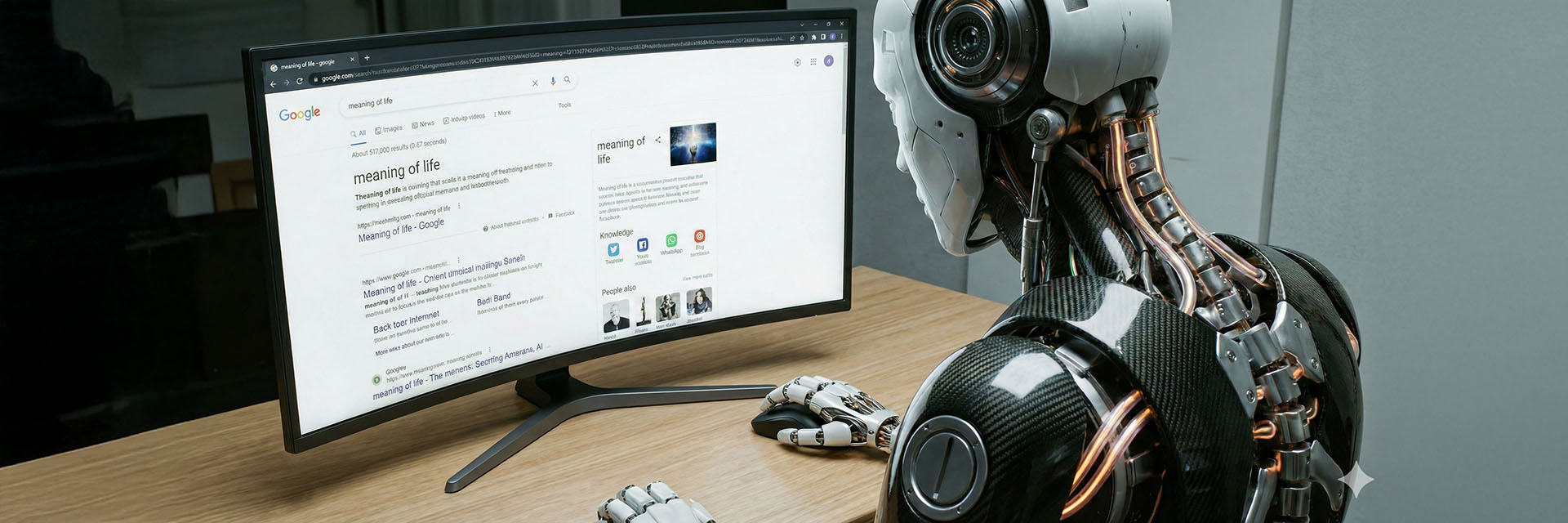
Traditional search is still the web’s primary entry point, including for AI agents. MSP-1 doesn’t compete with that. It starts where SEO stops: the moment an agent decides what to trust, reuse, summarize, or ignore.
Search didn’t disappear, it was absorbed
Lower search click-through does not mean people stopped using the web. It means more of the web is being consumed through AI-mediated interfaces: summaries, synthesized answers, and recommendations.
The demand for information remains. The path to it is changing.
From navigation to mediation
Traditional search optimized for navigation: lists of links and user-driven page selection. Answer engines optimize for mediation: they evaluate multiple sources, synthesize responses, and decide what to cite, paraphrase, or omit.
This shift changes the visibility model from “who gets clicked” to “who gets used.”
Visibility becomes citation, not traffic
In an AI-mediated interface, ranking is not the finish line. The new scarcity is citation: being selected as a source, quoted accurately, and reused consistently.
Influence increasingly accrues to the sources that answer engines feel safe relying on, even when the user never visits the page directly.
Citation discovery is selective by design
AI systems do not cite everything they find. They filter aggressively based on clarity of purpose, consistency of meaning, and confidence in interpretation.
If a system cannot quickly determine what a page is and how it should be read, it is more likely to hedge, blend, or skip it entirely. Ambiguity becomes a visibility penalty.
Why SEO only solves half the problem
SEO remains essential for discovery: crawlability, indexing, and relevance signals still matter. But SEO metadata does not reliably declare: interpretive framing, provenance, or scope-bound trust posture.
When those signals are missing, systems must infer. Inference adds variance, cost, and error risk, especially at scale.
The modern pipeline
Search → Candidate Set → Evaluation → Citation / Reuse
Search produces candidates. Evaluation determines confidence. Citation determines influence.
Discovery gets you seen. Clarity gets you used.
A new baseline for the AI-mediated web
As answer engines grow, the question shifts from “How do I get clicked?” to “How do I make sure my content is selected, interpreted correctly, and reused?”
The move from search discovery to citation discovery is already underway. Sites that adapt may not always see more direct traffic, but they gain something more durable: ongoing relevance in how knowledge is assembled.